We ran the numbers on the three most popular EV tariffs in the UK right now: Octopus Intelligent Go vs EDF Go Electric, and British Gas Electric Driver. The winner might surprise you.
If you charge your electric vehicle at home, you’re almost certainly overpaying. Most EV drivers are still on a standard flat-rate tariff — often paying 24p–27p per kWh overnight — when dedicated EV tariffs can cut that to under 10p during off-peak hours.
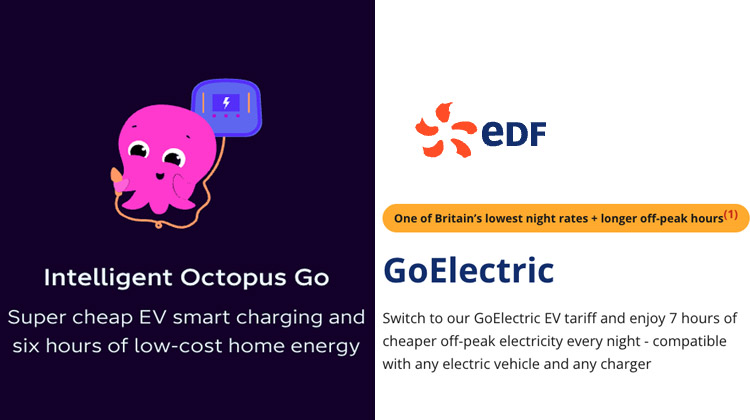
The short answer – Octopus Intelligent Go vs EDF Go Electric?
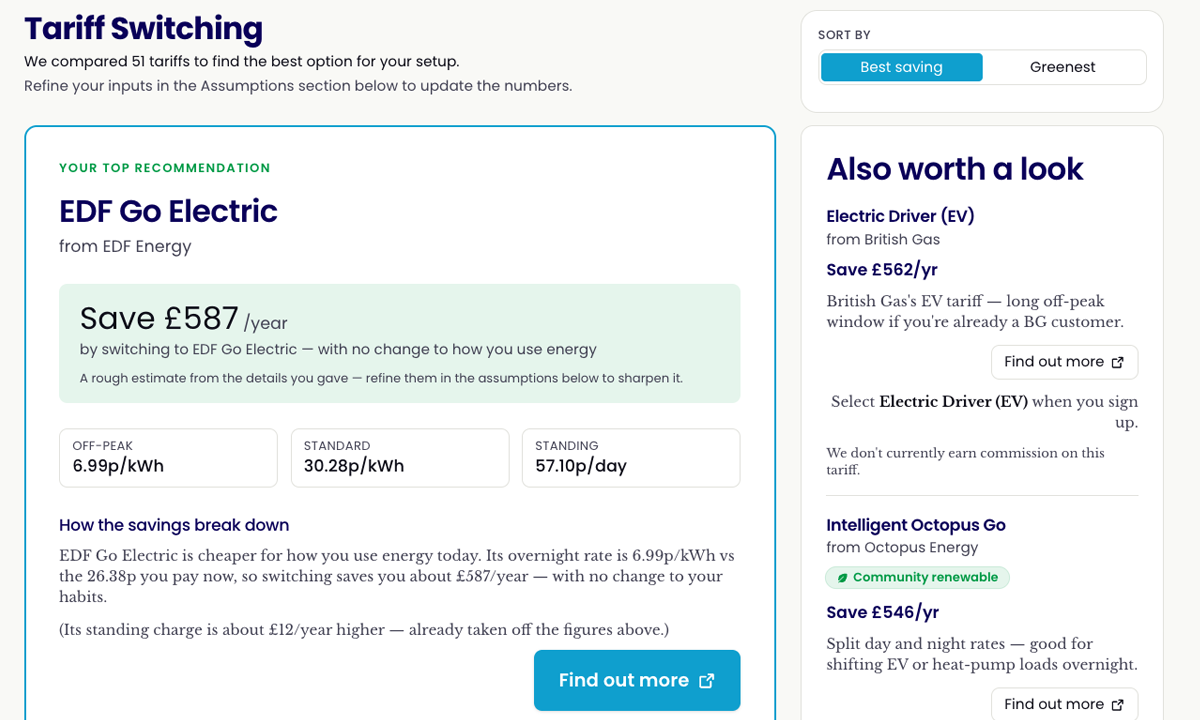
For a typical EV household in the London region, annualised savings versus a standard ~26.4p flat overnight rate looked like this:
| Tariff | Estimated annual saving |
|---|---|
| 🥇 EDF Go Electric | £587 |
| 🥈 British Gas Electric Driver | £562 |
| 🥉 Octopus Intelligent Go | £546 |
EDF Go Electric comes out on top — and given that Octopus Intelligent Go is the most talked-about EV tariff in the UK, that’s worth unpacking.
NB: These figures are for one specific household, usage pattern, and region. Your saving will vary — keep reading for the caveats or use the time-of-use tariff checker to get your result.
The off-peak rates and charging windows
The number that actually determines how much you save is the off-peak rate and how many hours per night you get it.
| Tariff | Off-peak rate | Cheap window | Cheap hours | Smart charger needed? |
|---|---|---|---|---|
| EDF Go Electric | 6.99p | 10pm–5am | 7 hours | No |
| Octopus Intelligent Go | ~7p | 11:30pm–5:30am | 6 hrs + smart slots | Yes |
| British Gas Electric Driver | 8.95p | Midnight–5am | 5 hours | No |
Why EDF Go Electric wins on a like-for-like basis
Three things work in EDF’s favour:
- The lowest headline off-peak rate. At 6.99p/kWh, EDF edges below both British Gas (8.95p) and Octopus Intelligent Go (~7p). That fraction of a penny adds up across every charge, every night.
- The longest cheap window — and it starts earlier. Seven hours of cheap electricity from 10pm is genuinely useful. Plug in after dinner and you’re already in the cheap window. Compare that to Intelligent Go’s 11:30pm start or British Gas’s midnight cutoff. If you have a larger battery (60kWh+) or charge every night, those extra hours matter.
- No charger requirement. EDF Go Electric works with any EV and a standard smart meter. Octopus Intelligent Go requires a compatible smart charger — Ohme, Zappi, Hypervolt, or Indra — plus a verified test charge before you can switch. That’s a meaningful barrier if you’re on a dumb charger or a granny cable. Check out better EV chargers and cables.
The honest case for Octopus Intelligent Go
If you only read the table above, you might conclude Octopus Intelligent Go is a disappointment. That would be unfair.
Our comparison uses each tariff’s fixed cheap window only. Octopus Intelligent Go is a smart tariff — it communicates with your charger to grab additional cheap half-hours outside the core 11:30pm–5:30am window when grid demand is low. In practice, this can meaningfully close or reverse the gap with EDF, particularly for drivers who charge frequently or have larger batteries.
The fairest framing: on a fixed-window, like-for-like basis, EDF’s longer 7-hour window edges it — but Intelligent Go’s smart charging optimisation can close or reverse that gap for the right driver.
If you already have a compatible smart charger, Intelligent Go is absolutely worth modelling for your specific situation.
What about British Gas Electric Driver?
British Gas Electric Driver is a decent tariff let down by a shorter window and a higher off-peak rate. Its main selling point is simplicity — no smart charger needed — and loyalty convenience if you’re already a British Gas customer. For anyone switching cold, EDF’s numbers are stronger on both dimensions that count.
What you actually need to check before switching
- Your region matters. Day rates, standing charges, and sometimes off-peak rates vary by DNO area. EDF’s day rate in our example region was 30.28p with a 57.10p/day standing charge. British Gas standing charges range from ~45p to 66p/day depending on region. Run your own numbers.
- These rates move. The figures above were verified in July 2026. EV tariffs are revised quarterly — re-check current rates before switching.
- Your charger. If you want Intelligent Go, check the Octopus compatibility list first.
- Your usage pattern. A driver doing 8,000 miles/year charging every night will see very different savings to one topping up twice a week.
The bottom line: Octopus Intelligent Go vs EDF Go Electric
If you want the simplest switch with the strongest headline numbers right now — any EV, no smart charger needed — EDF Go Electric is hard to beat. Seven hours of sub-7p electricity from 10pm, no hoops to jump through.
If you have a compatible smart charger and want a tariff that actively optimises your charging around the grid, Octopus Intelligent Go deserves a proper look — our static comparison likely undersells it.
Either way, if you’re still on a flat-rate tariff, or don’t know which electricity tariff you’re on, switching is one of the highest-return decisions an EV driver can make.
Want to see how these tariffs compare for your actual usage? Try our EV tariff checker →