If you’re looking for the best tariff for EV and heat pump homes our Smart Tariff Calculator which uses your real electricity usage rather than generic averages, is designed specifically for you.
Smart Tariffs are here to stay
The number of smart electricity tariffs available in the UK has expanded rapidly over the last couple of years. What was once a relatively simple market has become increasingly complicated, particularly for households with an electric vehicle, heat pump or electric heating.
There are now dedicated EV tariffs with cheap overnight electricity, heat pump tariffs designed around heating demand, dynamic tariffs like Agile where prices change every half hour, and a growing range of time-of-use tariffs designed to encourage households to shift electricity usage away from peak demand periods.
For many homeowners, these tariffs can reduce electricity bills significantly. But identifying the right tariff, especially the best tariff for EV and heat pump, is becoming much harder.
Most comparison websites still rely on generic “average household” assumptions which fail to reflect how modern electric homes actually use electricity. A household with a heat pump that also charges an EV overnight behaves very differently from a gas-heated home with low evening demand. The same is true for homes running electric heating systems.
That is exactly why we built the Smart Tariff Calculator
Why most tariff comparison tools struggle
Traditional tariff comparison tools were designed for a much simpler energy market. They generally work reasonably well for homes with predictable electricity usage and gas central heating, but they become far less accurate once large electrical loads are introduced.
Electric vehicles, heat pumps and electric heating systems all change not just how much electricity a household uses, but when it uses it. That distinction matters because smart tariffs are heavily dependent on timing.
A household that can shift large amounts of electricity consumption into cheap overnight periods may benefit enormously from one tariff, while another household with similar annual consumption but different behaviour could end up paying more.
This is one of the major limitations of many mainstream comparison sites. They often compare tariffs using estimated annual usage totals without properly modelling the timing of electricity demand.
Finding the best tariff for EV and heat pump homes requires knowing your actual usage
Our Smart Tariff Calculator takes a more detailed approach.
Instead of relying entirely on estimates, it can work from your actual smart meter data if you are with Octopus Energy, helping build a much more realistic picture of how your household consumes electricity throughout the day and across the year.
If you are not an Octopus customer, the tool can also estimate your annual electricity consumption from uploaded bills, or work directly from your known annual usage figures if you already have them available.
The aim is to move away from generic assumptions and towards modelling how your own home actually behaves to gain more accurate savings estimates.
Designed specifically for EVs, heat pumps and electric heating
One of the biggest differences with the calculator is that it does not simply ask for your annual electricity consumption and stop there. Different technologies create very different electricity demand patterns, so the calculator asks additional questions depending on your setup.
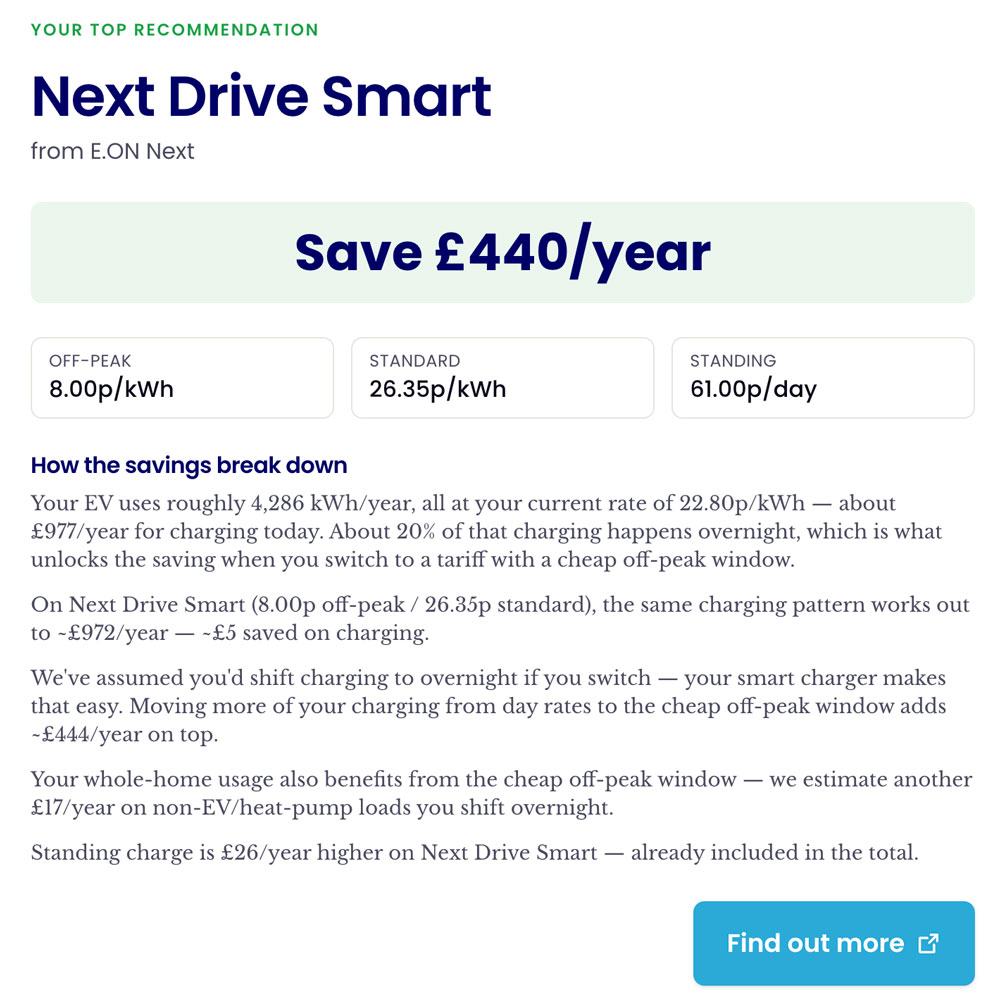
For EV owners, it’s really hard to compare Intelligent Octopus Go vs E.ON Next Drive directly without a lot more details and some pretty complicated math. So our EV tariff calculator considers your cars’ efficiency, annual mileage, charger type and charging behaviour. Since EV charging can often be shifted into cheap-rate periods, understanding how and when you charge can make a major difference to tariff recommendations.
For heat pump households, the calculator attempts to account for heating demand and how electricity usage changes seasonally, especially during winter when consumption often rises sharply. Compare heat pump tariff rates by region →
Homes with electric heating systems also behave very differently depending on the type of heating installed and how it is used. Storage heaters, direct electric heating and underfloor systems all create different usage profiles which can dramatically affect which tariff works best.
Comparing tariffs properly — including Agile
One of the hardest tariffs to compare accurately is Octopus Energy Agile. Because Agile prices change every half hour, simply looking at average rates tells you very little about what your actual annual bill might be.
The calculator therefore maps an entire year of half-hourly Agile pricing data against your actual usage (or estimated usage profile depending on your inputs) in order to model exact potential savings.
This matters because some households can benefit significantly from Agile pricing while others may find more predictable fixed time-of-use tariffs work better for their usage patterns. Without modelling actual behaviour, it’s impossible to compare these tariffs meaningfully.
Confidence scores and editable assumptions
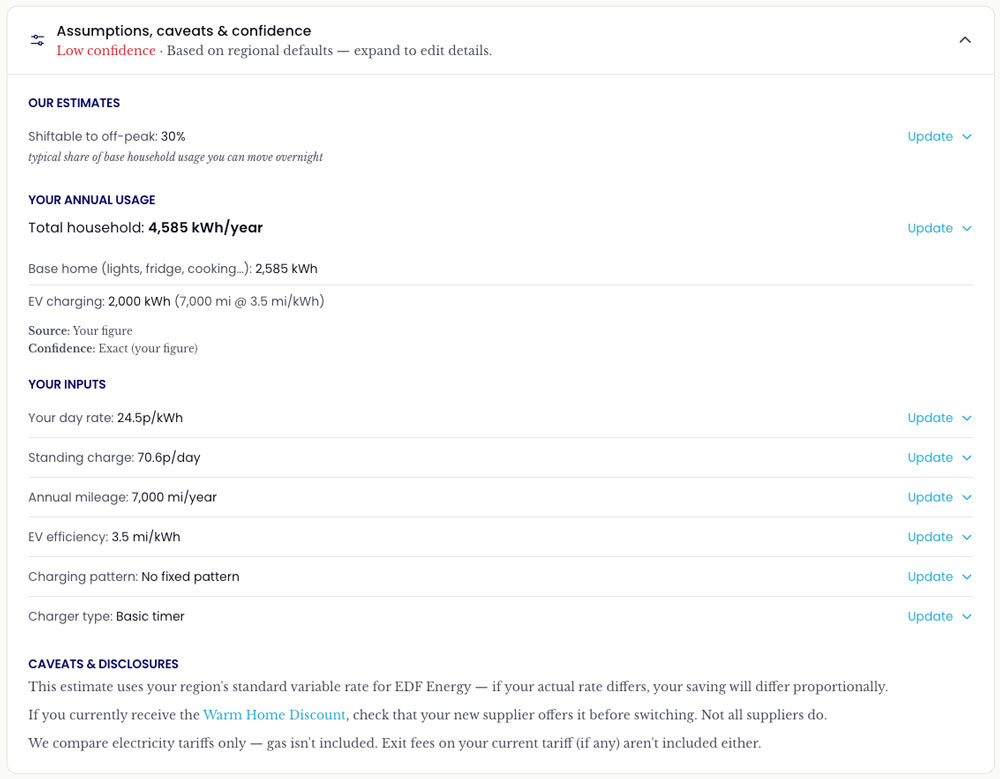
Another problem with many comparison tools is that they present their results as though they are perfectly precise, even though all tariff modelling involves assumptions. Our Smart Tariff Calculator includes a confidence score alongside the results and explains the assumptions used to generate the recommendations.
It also allows you to edit the inputs directly from the results page so you can refine the calculations further.
For example, you may decide to adjust annual mileage, charging times, heating behaviour or electricity usage estimates. As the inputs become more accurate, the recommendations become more tailored to your real-world situation.
Calculating the best tariff for EV and heat pump homes – an example
Lets look at an example household that owns an EV and a heat pump in London, that are on the Standard Variable Rate (the default tariff prices if they have not switched to a specific tariff) at the Ofgem cap — 26.35p/kWh + 44.78p/day standing charge (Jul–Sep 2026 rates) paying on direct debit and using 10,000 kWh/yr.
For this example we’ll assume they have a fairly efficient EV which does 4.2 mi/kWh, they drive 7,000 mi/yr, they have a smart charger, and that they already charge overnight. They also have a heat pump, live in 3-bed home with average insulation, and the heat pump works on a timer.
With this set up and a split of 2,700 kWh for their base home load, 1,667 kWh for the EV, and 4,000 kWh for the heat pump they would be paying a current annual bill of £2,403 for electricity.
Here are the savings they could make from the top 3 smart, time of use tariffs:
Tariff | Off-peak rate / hours | Standard rate | New cost | Saving |
| EV Saver (ScottishPower) | 8.5p / 5h | 24.9p | £1,944 | £459/yr |
| Heat Pump & Save Tracker (EDF) | 16.35p / 6h | 26.35p | £1,985 | £418/yr |
| Octopus Go | 8.63p / 5h | 30.99p | £1,991 | £412/yr |
There are several things to note about these savings:
The cheap rate isn’t what decides it. EV Saver and Octopus Go have near-identical off-peak rates (8.5p vs 8.63p), but Go’s standard rate is 30.99p against EV Saver’s 24.9p. With 8,500 kWh and only ~5 hours a night to shift into, most of this home’s energy is still billed at the standard rate — so the day rate decides the winner, not the headline off-peak.
EDF’s tracker wins its place differently. A 16.35p off-peak is nearly double the others, but it carries no standing charge (saving ~£163/yr on its own) and its standard rate matches the SVR exactly. It’s a lower-risk, lower-ceiling option.
The savings assume they already shift overnight. The main part of the savings come from simply switching to a smart tariff without any change in behaviour. But our calculator separately estimates another £351 (EV Saver) or £349 (Go) if they shift more load into the window. That upside is roughly as large as the switch itself – although it’s modelled rather than measured.
Two caveats on precision: every figure is estimated confidence; this is a modelled household that has not connected their half-hourly meter data, and 8,500 kWh is on the low side for EV-plus-heat-pump household, if the real heat pump load is higher, the savings grow.
Which all goes to show how complex – and device and behaviour specific – smart tariff calculations must be to reveal the real available savings.
Why smart tariff comparison matters more than ever
Time-of-use tariffs have become far more common over the last 18 months and the number of specialist tariffs aimed at EVs and electric heating continues to grow. That is good news for households willing to shift electricity demand into cheaper periods, but it also means choosing the wrong tariff can now be more expensive than before.
A tariff that appears cheap based on headline rates may not actually suit your household at all once real usage patterns are taken into account. For homes with EVs, heat pumps or electric heating, proper tariff comparison is becoming increasingly important.
Try the Smart Tariff Calculator UK to find the best tariff for EV and heat pump
If you want to compare smart tariffs using real usage data rather than generic averages, try the Smart Tariff Calculator using your own figures and your own details – you might be surprised what you can save.