We compare Intelligent Octopus Go vs E.ON Next Drive.
If you own an electric vehicle and you’re still on a standard electricity tariff, there’s a good chance you’re paying more than you need to for charging.
Over the last couple of years, energy suppliers have launched a wave of specialist EV tariffs with cheaper overnight electricity rates designed around when electric cars are usually plugged in. Two of the best-known are:
- Octopus Energy’s Intelligent Octopus Go
- E.ON Next’s Next Drive
At first glance they can look quite similar: both offer cheaper electricity overnight so you can charge your EV for less. But once you look more closely, the differences become more important — especially if you charge frequently, work from home, have solar panels, a battery, or eventually plan to add a heat pump.
The problem is that most comparison websites still compare tariffs using “average household” electricity usage profiles, which often bear little resemblance to how EV households actually use power.
That means the “cheapest” tariff on a comparison site may not actually be the cheapest for you.
Why EV tariffs can save so much money
Traditional electricity tariffs charge the same unit rate all day. Time-of-use (ToU) tariffs work differently. Electricity becomes cheaper at certain times — usually overnight when national demand is lower.
For EV drivers, that matters because charging an electric car can easily become one of the biggest electricity uses in the home. If you can move most of that charging into cheap-rate periods, the savings can be substantial.
Depending on mileage and charging habits, some EV owners save hundreds of pounds per year simply by switching to an EV tariff and charging overnight.
How Intelligent Octopus Go works
Octopus Energy’s Intelligent Octopus Go is one of the most advanced EV tariffs currently available in the UK.
Like a standard EV tariff, it offers a cheap overnight charging window. But the “Intelligent” part comes from the fact that Octopus can directly control compatible EVs or chargers and automatically schedule charging when electricity is cheapest.
Instead of simply giving you a fixed cheap period overnight, the system can intelligently spread charging around lower-demand periods.
In practice, this means:
- Your car can automatically charge at the cheapest times
- Charging is optimised without needing manual scheduling
- Some households can benefit from additional low-cost charging slots outside the standard overnight window
For many EV owners, the convenience is a major selling point. You plug in the car and let the system handle the rest. However, compatibility matters. Intelligent Octopus Go only works with supported vehicles and chargers.
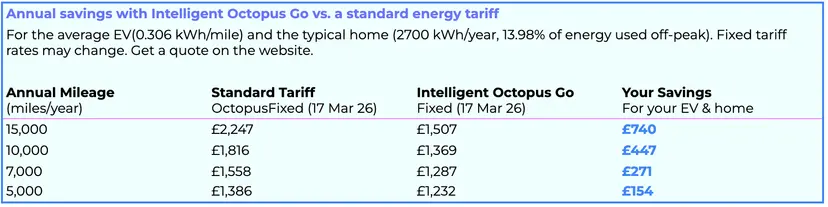
Octopus claim the following savings are available on the Intelligent Octopus Go tariff, compared to their standard fixed tariff:
How E.ON Next Drive works
E.ON Next’s Next Drive tariff takes a more traditional approach. You get a fixed cheap overnight charging window each night, during which electricity costs less. The structure is simpler and easier to understand:
- Cheap electricity is available during set overnight hours
- You manually schedule your car or charger to use those hours
- No intelligent smart charging integration is required
For many households, this simplicity is actually attractive. You don’t need to worry about compatibility with a particular charger or vehicle ecosystem. If your EV or charger can schedule charging overnight, you can usually make use of the tariff.
Intelligent charging vs fixed charging windows – Intelligent Octopus Go vs E.ON Next Drive
One of the biggest differences between Intelligent Octopus Go vs E.ON Next Drive is flexibility.
Intelligent Octopus Go
The tariff is designed around smart optimisation and its advantages include:
- Automated charging schedules
- Potential access to additional low-cost charging periods
- Less manual management
- Better integration with smart energy systems
Possible downsides:
- Vehicle/charger compatibility requirements
- More complex setup
- Less predictable charging windows
E.ON Next Drive
The tariff focuses on simplicity and predictability. and its advantages include:
- Fixed cheap-rate periods
- Easier to understand
- Works with most scheduled EV charging setups
- No advanced integrations needed
Possible downsides:
- Less flexibility
- Fewer opportunities to optimise around changing electricity demand
- May not suit households wanting advanced smart energy automation
Intelligent Octopus Go vs E.ON Next Drive – Which tariff is actually cheaper?
This is where things get complicated. There is no universal answer when you compare Intelligent Octopus Go vs E.ON Next Drive generically. Octopus’ overnight cheap rate is currently 8p/kWh and E.ON’s is 9p/kWh but the cheapest tariff for you also depends on:
- How many miles you drive
- When you charge
- Whether you work from home
- Your daytime electricity usage
- Whether you have solar panels
- Whether you have a home battery
- Your regional electricity pricing
- Your EV charging efficiency
- How much electricity you can shift overnight
This is where most comparison websites struggle. Many major comparison sites still estimate energy usage using broad “average household” assumptions. But EV households are rarely average. A household driving 15,000 miles per year and charging overnight behaves very differently from a non-EV household.
A better way to compare EV tariffs
At Smart Home Energy, we built an EV tariff comparison tool specifically because standard comparison methods often don’t work well for EV households. Our EV Time-of-Use Tariff Checker uses your actual smart meter data (for Octopus customers), real bills, or your exact kWh usage. It collects details about your car type and annual mileage so it can model your usage against all the smart tariffs currently available, including EV tariffs and dynamic tariffs like Agile to show you whether you’d actually save money — or potentially pay more by switching.
Instead of using generic “average household” assumptions, it looks at how you use electricity. That gives a much more realistic comparison for EV owners.
Should you switch to an EV tariff?
If you own an EV and regularly charge at home, it is definitely worth checking. Even households already on an EV tariff are sometimes surprised to find another tariff would work better for their actual usage pattern.
And many EV owners still have no idea how much difference time-of-use pricing can make. The key point is that the best tariff is highly personal. What works brilliantly for one EV household may be poor value for another.
Try the EV Tariff Checker
If you want to compare Intelligent Octopus Go vs E.ON Next Drive properly — using your own electricity usage rather than generic assumptions — you can run your numbers through our calculator here: EV Time-of-Use Tariff Checker. Let us know if you see significant savings.